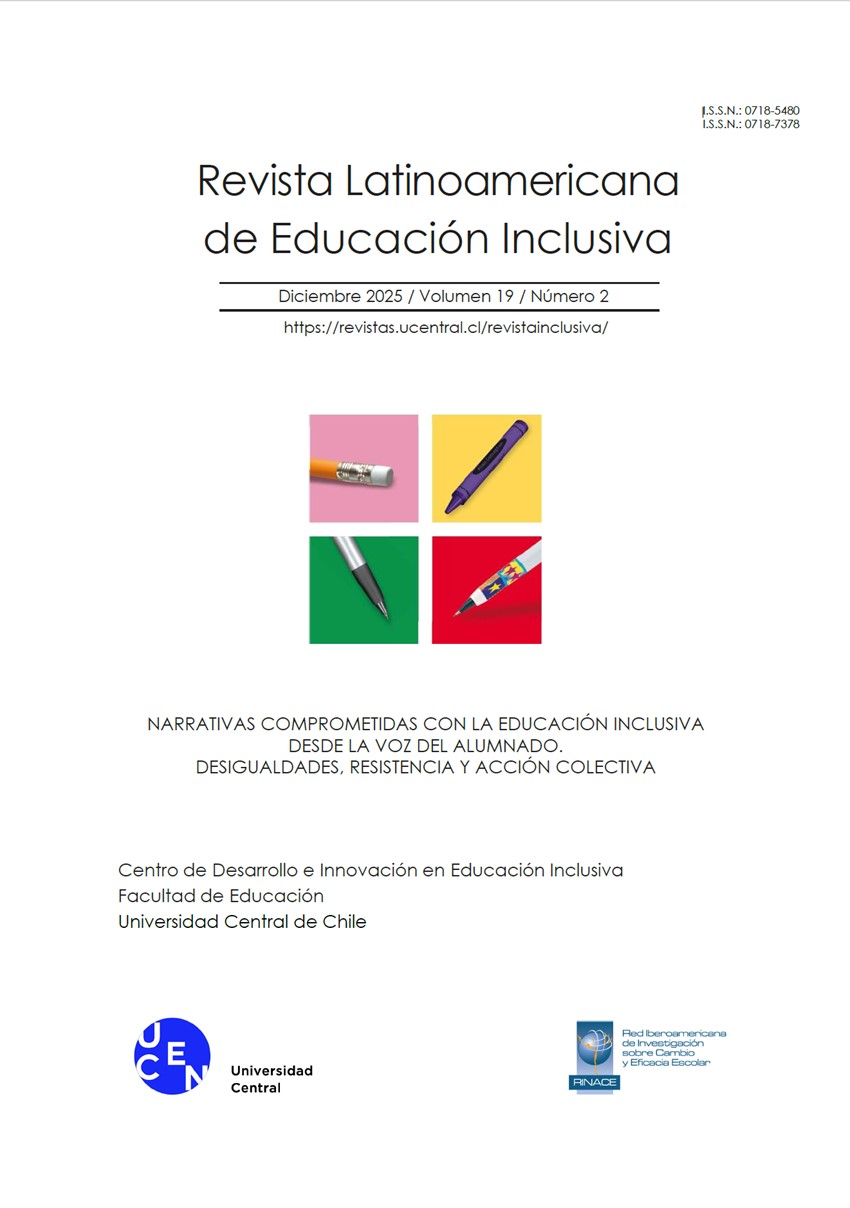
Narrativas Comprometidas com a Educação Inclusiva a partir da Voz dos Alunos. Desigualdades, Resistência e Ação Coletiva
DOI:
https://doi.org/10.4067/S0718-73782025000200017Palavras-chave:
Educação inclusiva, Voz dos alunos, Desigualdades educativas, Resistência, Ação coletivaResumo
O projeto de tornar as escolas inclusivas não surgiu por capricho ou por uma ideia repentina, nem se trata de uma moda passageira. Ele nasceu como resposta ao desejo coletivo de que os sistemas educativos de todo o mundo pudessem acolher todas as crianças, sem exceção, algo que foi abordado na conhecida Conferência Mundial realizada em Jomtien (UNESCO, 1990). Alguns anos depois, a educação inclusiva surgiu na Conferência Mundial de Salamanca como a forma ideal de alcançar esse desejo (UNESCO, 1994). Uma década depois, a educação inclusiva seria considerada um direito humano fundamental (ONU, 2006).
Esses três marcos foram fundamentais, sim. No entanto, o projeto revolucionário de tornar as nossas escolas inclusivas foi-se desvalorizando com o tempo. Hoje fala-se de educação inclusiva para se referir até mesmo a práticas excludentes, distantes daquele desejo. Em muitos lugares, a linguagem é pervertida, distorcida a ponto de roubar o valor humano do projeto. Em outros, chega-se até a proibir o uso de certas palavras que associam a diversidade humana à luta contra a desigualdade. As nossas diferenças tornam-se o alvo a ser derrubado pela agenda ultraconservadora aqui e ali, o que evidencia o seu potencial transformador.
Referências
Ainscow, M., Calderón-Almendros, I., Duk, C., & Viola, M. (2025). Using professional development to promote inclusive education in Latin America: possibilities and challenges. Professional Development in Education, 51(1), 149-166. https://doi.org/10.1080/19415257.2024.2427285
Ainscow, M. y Messiou, K. (2018). Engaging with the views of students to promote inclusion in education. Journal of Education Change, 19, 1-17. https://doi.org/10.1007/s10833-017-9312-1
Castells, M. (1997). El poder de la identidad. Alianza.
Fielding, M. (2004). Transformative approaches to student voice: Theoretical underpinnings, recalcitrant realities. British Educational Research Journal, 30(2), 295-311. https://doi.org/10.1080/0141192042000195236
Fielding, M. (2010). The radical potential of student voice: Creating spaces for restless encounters. International Journal of Emotional Education, 2(1), 61-73.
Fielding, M. (2011). La voz del alumnado y la inclusión educativa: Una aproximación democrática radical para el aprendizaje intergeneracional. Revista Interuniversitaria de Formación del Profesorado, 70(25,1), 31-61.
Fielding, M. (2012). Beyond student voice: patterns of partnership and the demands of deep democracy. Revista de Educación, 359, 45-65. https://doi.org/10.4438/1988-592X-RE-2012-359-195
ONU. (2006). Convención de las Naciones Unidas sobre los Derechos de las Personas con Discapacidad. ONU.
Skliar, C. (2010). De la razón jurídica hacia una ética peculiar. A propósito del informe mundial sobre el derecho a la educación de personas con discapacidad. Política y Sociedad, 47(1), 153-164.
Soldevila, J., Calderón, I. y Echeita, G. (2024). Mi vida (escolar) es prescindible: radicalizar un discurso contra las miserias del sistema escolar. En J. Collet, M. Naranjo y J. Soldevila (Eds.), Educación inclusiva global (pp. 41-62). Octaedro. http://doi.org/10.36006/09627-1
UNESCO. (1990). Conferencia Mundial sobre Educación para Todos: Satisfacción de las necesidades básicas de aprendizaje. UNESCO.
UNESCO (1994). Conferencia Mundial sobre Necesidades Educativas Especiales: Acceso y calidad. UNESCO.
Publicado
Como Citar
Edição
Seção
Licença
Copyright (c) 2025 Revista Latinoamericana de Educación Inclusiva

Este trabalho está licenciado sob uma licença Creative Commons Attribution 4.0 International License.
Creative Commons Reconocimiento (by)
Esta licença permite a exploração da obra, bem como a criação de obras derivadas, cuja distribuição também é permitida, desde que seja feita referência expressa ao autor, ou seja, que seu nome apareça em qualquer uso ou ato de exploração da obra.